

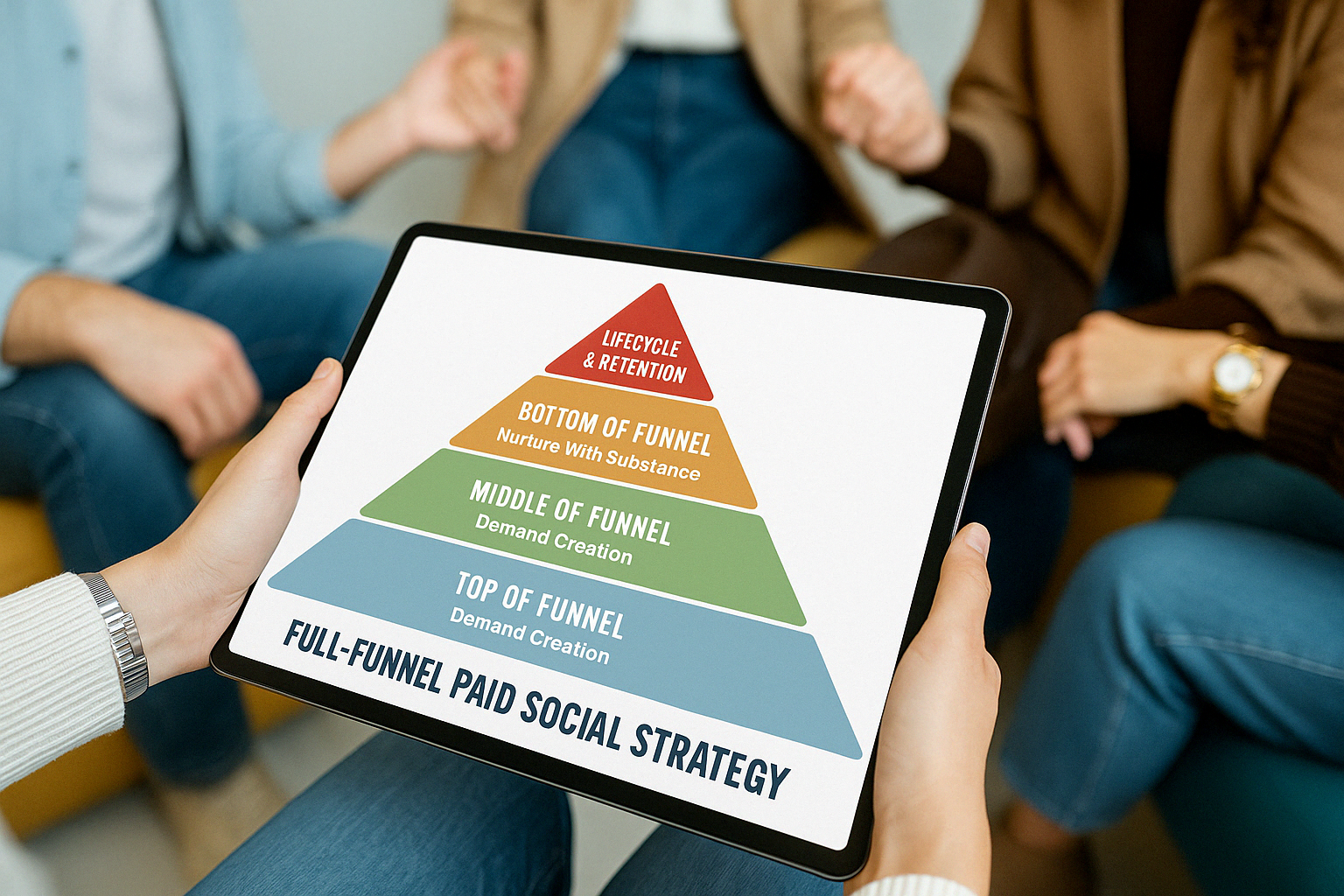
From Scroll to Sale: How to Build a Full-Funnel Paid Social Strategy

In a time when attention is fragmented, brand trust is low, and ad costs are rising, the brands that win are those who don’t just advertise they architect experiences.

Forget spray-and-pray campaigns. Today’s high-performing marketers are building sophisticated full-funnel paid social systems that guide users through layered stages of discovery, trust, and conversion. These are not just media buys they are orchestrated journeys that move people from “Who are you?” to “Take my money.”

This is not theory. This is how modern growth engines are built content-led, signal-rich, and precision-targeted.

Let’s break it down.

Why Full-Funnel Still Wins… When Done Right

Despite what clickbait says, the funnel is not dead. What has changed is that today’s funnel is:

  • Non-linear: Users don’t move step-by-step. They jump between touch-points, channels, and content types.
  • Content-intensive: The user journey is now built on micro-content moments — not long-form hero campaigns.
  • Signal-driven: The best funnels are powered by real-time behavioural data — not assumptions.

A content-led paid funnel lets you:

  • Match messaging to intent and awareness levels
  • Optimise media spend across high-yield segments
  • Reduce CPA while improving CAC:LTV ratios
  • Build brand equity before conversion pressure

Now let’s go stage by stage — with specialist-level detail.

Top of Funnel (TOFU): Demand Creation, Not Just Awareness

At TOFU, your mission isn’t just to be seen… it’s to manufacture curiosity in a saturated feed.

Objectives:

  • Introduce the problem or opportunity
  • Build relevance, not reach for its own sake
  • Collect engagement signals for retargeting pools

Content Formats:

  • Native short-form video optimised for silence and speed (e.g., 5-second pattern interrupts)
  • Swipe-worthy carousels breaking down “3 Trends You Didn’t Know You’re Missing”
  • Memetic content (on-brand memes or reactive takes) that feed into culture

Platform Tactics:

  • Meta: Use Reels placement + Interest targeting + Broad targeting with Advantage+ creative
  • TikTok: Spark Ads + creator UGC that frames the problem with social proof
  • LinkedIn: For B2B, pulse content tied to emerging industry shifts or new regulatory impacts

Specialist Tip:

Structure TOFU as creative testing grounds, not conversion stages. Run broad campaigns with 5–7 creative hooks, then kill off under-performers fast. Use data here to inform what your audience actually cares about.

Middle of Funnel (MOFU): Nurture With Substance and Signals

You’ve captured interest. Now it’s time to earn trust and move beyond surface-level awareness.

Objectives:

  • Educate without overwhelming
  • Present your offer as inevitable, not optional
  • Deepen behavioural signals (clicks, site visits, saves)

Content Formats:

  • Mini case studies (e.g., “How [Customer] Reduced Costs by 27% in 30 Days”)
  • Product-in-context videos showing use cases, not specs
  • Thought leadership carousels from your founder or expert team
  • Interactive lead magnets: quizzes, audits, calculators

Platform Tactics:

  • Meta: Retarget 50–75% video viewers or page engagers; use lead-gen forms with conditional logic
  • TikTok: Reframe initial pain point with deeper product validation (creators explaining vs performing)
  • LinkedIn: Highlight client logos, quotes, analyst recognition or industry reports

Specialist Tip:

Use UTM-layered tracking to capture what mid-funnel content is driving repeat touch-points. Your MOFU audience may not convert yet but you’ll know exactly which messages move them down-funnel.

Bottom of Funnel (BOFU): Conversion Without Friction

Now you’re speaking to a primed audience. They trust you. They’re comparing. Now it’s time to nudge, not shout.

Objectives:

  • Create clarity around pricing, results, and urgency
  • Eliminate objections
  • Create conversion momentum

Content Formats:

  • One-pager style ads showing price, features, results, CTA in one clean creative
  • Testimonial & UGC mashups (social proof with narrative)
  • Offer + Scarcity hooks (“Last chance for [Benefit] at 20% off”)

Platform Tactics:

  • Meta: Use Advantage+ Shopping Campaigns or retarget with DABA (Dynamic Ads for Broad Audiences)
  • TikTok: Direct-response UGC with clean CTA overlays and hooks in the first 3 seconds
  • LinkedIn: Lead-gen form ads using native forms with a “Book Your Free Consult” or “Download Custom Report” CTA

Specialist Tip:

A/B test intent-based copy (“Why 3,104 marketers chose X in 2025”) versus feature-heavy copy to see which converts faster. Feed this insight back up to inform TOFU creative.

Beyond the Funnel: Lifecycle and Retention

The most under-leveraged piece of the funnel? Post-conversion content. Acquisition is just the beginning of LTV.

Strategic Plays:

  • Onboarding series via retargeting (yes, ads to existing customers!)
  • Milestone content (“You’ve been with us 90 days – here’s what’s next”)
  • UGC requests and referral incentives

Retention content can cut churn, boost NPS, and drive community flywheel effects. All from paid media.

Measurement: The Funnel is Only as Good as the Data

You cannot optimise what you cannot measure.

Here is what you should track at each stage:

Funnel Stage Primary Metrics Secondary Signals
TOFU CPM, Thumb Stop Rate, Video Views Saves, Shares, Time on Content
MOFU CTR, Lead Form Completion Scroll depth, Tool interactions
BOFU ROAS, CAC, Purchase Conversion Rate Add-to-carts, Booking CTR, Checkout Abandon

Layer GA4, Meta Pixel, TikTok Pixel and server-side tracking to ensure your signals are firing cleanly across stages.

Final Thought

A full-funnel paid strategy is not just a sequence of ads. It is a systematic content engine designed to move people from strangers to superfans, from cold traffic to high-intent conversions.

If you treat every ad as a sale, you will bleed budget. But if you treat your funnel like a relationship, you’ll build brand equity and performance.

The scroll is the beginning. But the sale is the result of smart, layered storytelling.

How to Write Content That Doesn’t Just Educate…It Converts

In B2B marketing, content has long been used to build brand awareness, educate audiences, and drive thought leadership. But in today’s saturated digital landscape, simply being informative isn’t enough. Content must not only attract, you need to create content that coverts!

If your goal is real business impact measurable pipeline growth, qualified leads, and closed deals then your content needs to actively move users down the funnel. That means creating assets that are intentional, strategic, and tied directly to stages of the buyer journey.

Let’s break down exactly how to create content that does more than educate: it converts.

Step 1: Understand and Map Content to the B2B Buyer Journey

Marketing Edd illustration of how you map content to the buyer's journey
Mapping Content To The Buyer’s Journey

Before you even write a word, you must understand the psychology and behavior of your buyer. In B2B, the buyer journey is often longer and involves multiple stakeholders. Content should be mapped to each of these three core stages:

Awareness Stage

Buyers are problem-aware but not necessarily solution-aware. They’re researching, gathering insights, and looking for patterns in the pain points they’re experiencing. Your goal here is to create helpful, non-promotional content that educates and builds trust.

Content examples: SEO-optimized blog posts, educational videos, whitepapers, infographics, and industry trend reports.

Example CTA: “Download our guide to the top 10 [industry] challenges in 2025.”

Consideration Stage

Now that the buyer understands their problem, they’re comparing different types of solutions. They’re weighing the pros and cons, reading reviews, and evaluating vendors. Your content here should position your solution as a strong option, without pushing too hard.

Content examples: Case studies, comparison guides, webinars, product explainers, and email drip campaigns.

Example CTA: “See how we helped [Client] reduce costs by 40%—download the case study.”

Decision Stage

The buyer is ready to make a decision—they just need a final push. Now is the time for product-focused, benefit-driven content that eliminates any remaining objections and encourages action.

Content examples: Product demos, pricing calculators, testimonials, free trial landing pages, and ROI tools.

Example CTA: “Book a 15-minute demo to see [Product] in action.”

Step 2: Be Strategic with Content Formats

Marketing Edd Illustration On How To Be Strategic With Content Formats
How To Be Strategic With Content Formats

Not all content formats are created equal. Some are great for educating (blogs), while others are perfect for conversion (case studies, webinars, landing pages). To maximize conversions, choose formats that are best suited to each journey stage.

Buyer Stage Best Content Formats
Awareness Blog posts, ebooks, guides, reports, videos
Consideration Webinars, case studies, gated resources
Decision Free trials, product demos, testimonials, landing pages


Why this matters
: If you’re offering a demo to someone who’s just learning about the problem, you’re being premature. If you’re showing industry trends to someone ready to buy, you’re delaying the sale. The right format at the right time is key.

Step 3: Use SEO to Fuel Funnel Entry

You can’t convert what you can’t attract. That’s where SEO plays a critical role—especially in top-of-funnel (TOFU) and mid-funnel (MOFU) content. Your blog posts and landing pages should be optimized with keywords that match buyer intent at different stages.

Awareness SEO

Target keywords like “how to solve [problem],” “why does [problem] happen,” “top trends in [industry],” etc.

Example: “How to Prevent Downtime in Cloud Infrastructure”

Consideration SEO

Here, go after comparison and solution keywords like “best cloud monitoring tools,” “X vs Y platforms,” “solution for [pain point].”

Example: “Top 5 Cloud Monitoring Tools Compared”

Pro tip: Pair SEO research tools (e.g., SEMrush, Ahrefs) with Google Search Console insights to optimise performance, and build internal links between blog posts, case studies, and landing pages to keep users on-site and move them deeper.

Step 4: Craft Clear, Compelling CTAs (Not Just “Learn More”)

The most valuable content still fails if your CTA is weak. Think beyond vague CTAs like “learn more” or “read the full guide.” Your call to action should:

  • Be specific (“Download the free template”)
  • Highlight a benefit (“Get 50% more traffic with this checklist”)
  • Create urgency (“Spots limited—register for the webinar today”)

Each piece of content should be tied to a clear goal and corresponding CTA. Ask yourself: what is the next step I want this reader to take?

Tip: Use heatmaps or A/B testing tools to see how users engage with your CTA placements and formats.

Step 5: Build High-Converting Landing Pages

Once a prospect clicks your CTA, where they land matters just as much. A dedicated, conversion-optimized landing page is crucial for lead generation. Key components of a high-performing page include:

  • A clear headline and subheading
  • One main call to action (no distractions)
  • Visuals or short explainer video
  • Social proof (logos, testimonials, or stats)
  • A frictionless form (name + email is often enough at TOFU)

Avoid: Linking from a blog post CTA to your homepage or a generic services page. That’s a dead end. Every CTA should direct users to a page built with one goal in mind: conversion.

Step 6: Lead Magnets: Turn Traffic into Leads

Lead magnets are the bridge between education and conversion. They’re what take anonymous visitors and turn them into contacts in your CRM. But not all lead magnets work equally well.

Marketing Edd Illustration On Lead Magnets: Turn Traffic Into Leads
Lead Magnets: Turn Traffic Into Leads

The best-performing lead magnets are:

  • Specific (not just “ebook”—try “Checklist to Launch a B2B Webinar in 30 Days”)
  • Tangible (templates, calculators, swipe files)
  • Actionable (solve a real pain point)
  • Easy to consume (1-3 pages often outperform 30-page guides)

You should also tailor lead magnets to each audience segment. A CMO might want a strategy deck. A marketing ops leader might want a HubSpot audit checklist.

Step 7: Create Nurture Sequences That Sell

Once someone downloads your lead magnet, don’t stop there. Enter: email nurture.

Use 3-5 email sequences that guide leads from the consideration to decision phase, delivering content like:

  • Related blog posts or videos
  • Customer success stories
  • Invitations to product webinars
  • Personalised demo offers

Bonus: Use progressive profiling to capture more information as they engage, allowing your sales team to better qualify and convert.

Use Case Example: From Blog to Sale

Here’s how a single blog post can drive a sale when it’s backed by the right funnel strategy:

  1. SEO blog: “Top 5 Challenges in Enterprise IT Management”
  2. Embedded CTA: “Download the free checklist to streamline your IT operations”
  3. Landing page: Optimised with testimonials and 3-field form
  4. Email nurture: 4-email sequence with tips, success story, and webinar invite
  5. Webinar: “How [Your Company] Helped X Cut Downtime by 65%”
  6. Demo CTAe=”font-weight: 400;”>: Post-webinar email with exclusive trial offer
  7. Closed deal: From blog to paying customer in 3 weeks

Final Thoughts

weight: 400;”>Creating content that converts isn’t about guesswork. It’s a deliberate, data-informed process that connects content strategy with business outcomes. By mapping your content to the buyer’s journey, using strategic CTAs, optimising with SEO, leveraging high-converting formats, and nurturing leads post-conversion—you’re not just educating. You’re driving action.

If you want real results from your content marketing, it’s time to stop creating content for the sake of visibility—and start building content systems designed to convert.