

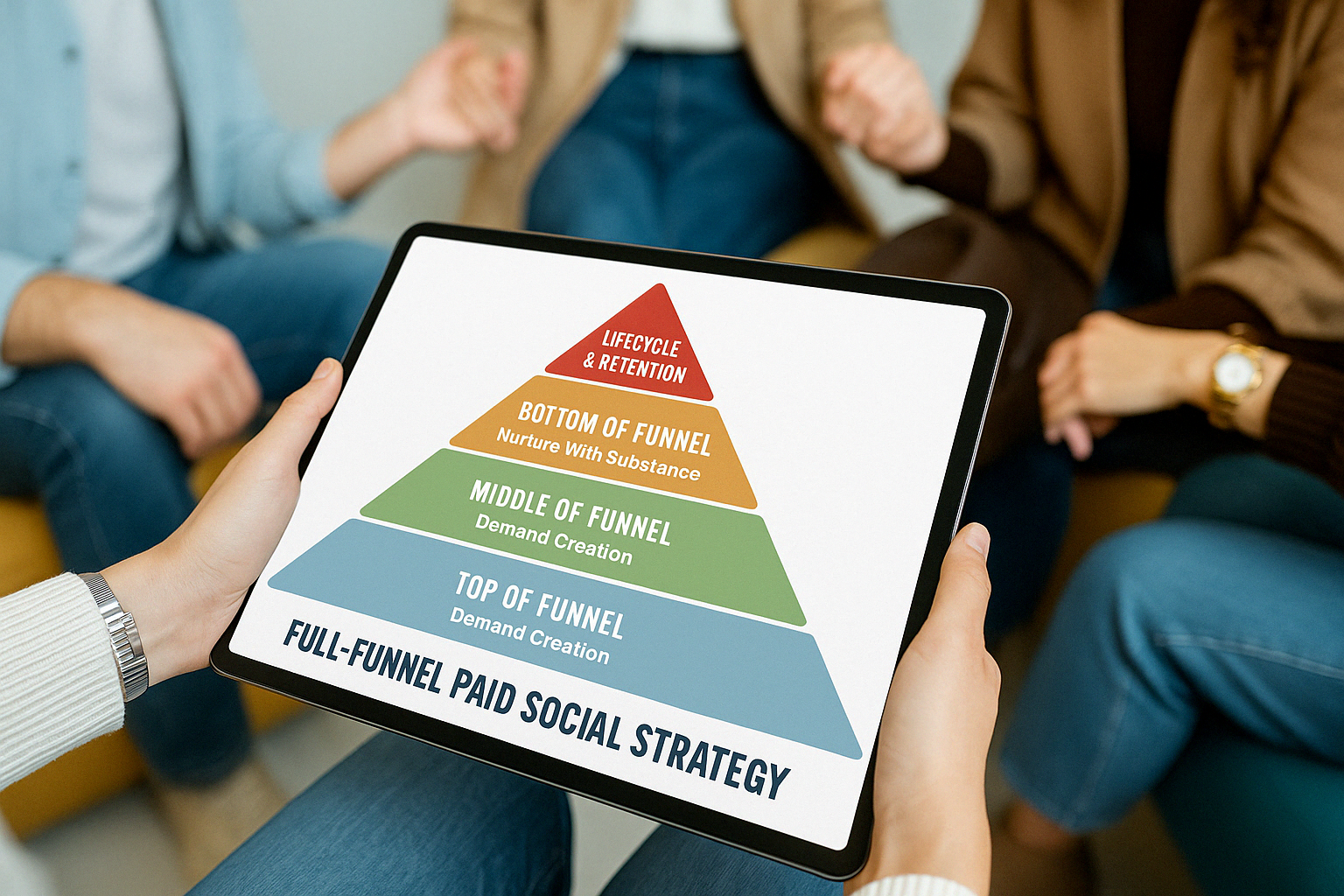
From Scroll to Sale: How to Build a Full-Funnel Paid Social Strategy
In a time when attention is fragmented, brand trust is low, and ad costs are rising, the brands that win are those who don’t just advertise they architect experiences.
Forget spray-and-pray campaigns. Today’s high-performing marketers are building sophisticated full-funnel paid social systems that guide users through layered stages of discovery, trust, and conversion. These are not just media buys they are orchestrated journeys that move people from “Who are you?” to “Take my money.”
This is not theory. This is how modern growth engines are built content-led, signal-rich, and precision-targeted.
Let’s break it down.
Why Full-Funnel Still Wins… When Done Right
Despite what clickbait says, the funnel is not dead. What has changed is that today’s funnel is:
- Non-linear: Users don’t move step-by-step. They jump between touch-points, channels, and content types.
- Content-intensive: The user journey is now built on micro-content moments — not long-form hero campaigns.
- Signal-driven: The best funnels are powered by real-time behavioural data — not assumptions.
A content-led paid funnel lets you:
- Match messaging to intent and awareness levels
- Optimise media spend across high-yield segments
- Reduce CPA while improving CAC:LTV ratios
- Build brand equity before conversion pressure
Now let’s go stage by stage — with specialist-level detail.
Top of Funnel (TOFU): Demand Creation, Not Just Awareness
At TOFU, your mission isn’t just to be seen… it’s to manufacture curiosity in a saturated feed.
Objectives:
- Introduce the problem or opportunity
- Build relevance, not reach for its own sake
- Collect engagement signals for retargeting pools
Content Formats:
- Native short-form video optimised for silence and speed (e.g., 5-second pattern interrupts)
- Swipe-worthy carousels breaking down “3 Trends You Didn’t Know You’re Missing”
- Memetic content (on-brand memes or reactive takes) that feed into culture
Platform Tactics:
- Meta: Use Reels placement + Interest targeting + Broad targeting with Advantage+ creative
- TikTok: Spark Ads + creator UGC that frames the problem with social proof
- LinkedIn: For B2B, pulse content tied to emerging industry shifts or new regulatory impacts
Specialist Tip:
Structure TOFU as creative testing grounds, not conversion stages. Run broad campaigns with 5–7 creative hooks, then kill off under-performers fast. Use data here to inform what your audience actually cares about.
Middle of Funnel (MOFU): Nurture With Substance and Signals
You’ve captured interest. Now it’s time to earn trust and move beyond surface-level awareness.
Objectives:
- Educate without overwhelming
- Present your offer as inevitable, not optional
- Deepen behavioural signals (clicks, site visits, saves)
Content Formats:
- Mini case studies (e.g., “How [Customer] Reduced Costs by 27% in 30 Days”)
- Product-in-context videos showing use cases, not specs
- Thought leadership carousels from your founder or expert team
- Interactive lead magnets: quizzes, audits, calculators
Platform Tactics:
- Meta: Retarget 50–75% video viewers or page engagers; use lead-gen forms with conditional logic
- TikTok: Reframe initial pain point with deeper product validation (creators explaining vs performing)
- LinkedIn: Highlight client logos, quotes, analyst recognition or industry reports
Specialist Tip:
Use UTM-layered tracking to capture what mid-funnel content is driving repeat touch-points. Your MOFU audience may not convert yet but you’ll know exactly which messages move them down-funnel.
Bottom of Funnel (BOFU): Conversion Without Friction
Now you’re speaking to a primed audience. They trust you. They’re comparing. Now it’s time to nudge, not shout.
Objectives:
- Create clarity around pricing, results, and urgency
- Eliminate objections
- Create conversion momentum
Content Formats:
- One-pager style ads showing price, features, results, CTA in one clean creative
- Testimonial & UGC mashups (social proof with narrative)
- Offer + Scarcity hooks (“Last chance for [Benefit] at 20% off”)
Platform Tactics:
- Meta: Use Advantage+ Shopping Campaigns or retarget with DABA (Dynamic Ads for Broad Audiences)
- TikTok: Direct-response UGC with clean CTA overlays and hooks in the first 3 seconds
- LinkedIn: Lead-gen form ads using native forms with a “Book Your Free Consult” or “Download Custom Report” CTA
Specialist Tip:
A/B test intent-based copy (“Why 3,104 marketers chose X in 2025”) versus feature-heavy copy to see which converts faster. Feed this insight back up to inform TOFU creative.
Beyond the Funnel: Lifecycle and Retention
The most under-leveraged piece of the funnel? Post-conversion content. Acquisition is just the beginning of LTV.
Strategic Plays:
- Onboarding series via retargeting (yes, ads to existing customers!)
- Milestone content (“You’ve been with us 90 days – here’s what’s next”)
- UGC requests and referral incentives
Retention content can cut churn, boost NPS, and drive community flywheel effects. All from paid media.
Measurement: The Funnel is Only as Good as the Data
You cannot optimise what you cannot measure.
Here is what you should track at each stage:
| Funnel Stage | Primary Metrics | Secondary Signals |
| TOFU | CPM, Thumb Stop Rate, Video Views | Saves, Shares, Time on Content |
| MOFU | CTR, Lead Form Completion | Scroll depth, Tool interactions |
| BOFU | ROAS, CAC, Purchase Conversion Rate | Add-to-carts, Booking CTR, Checkout Abandon |
Layer GA4, Meta Pixel, TikTok Pixel and server-side tracking to ensure your signals are firing cleanly across stages.
Final Thought
A full-funnel paid strategy is not just a sequence of ads. It is a systematic content engine designed to move people from strangers to superfans, from cold traffic to high-intent conversions.
If you treat every ad as a sale, you will bleed budget. But if you treat your funnel like a relationship, you’ll build brand equity and performance.
The scroll is the beginning. But the sale is the result of smart, layered storytelling.
